AI Search Optimization: Get Found on Google, ChatGPT & Perplexity
AI Search Optimization Guide · August 2026
What Is AI Search Optimization?
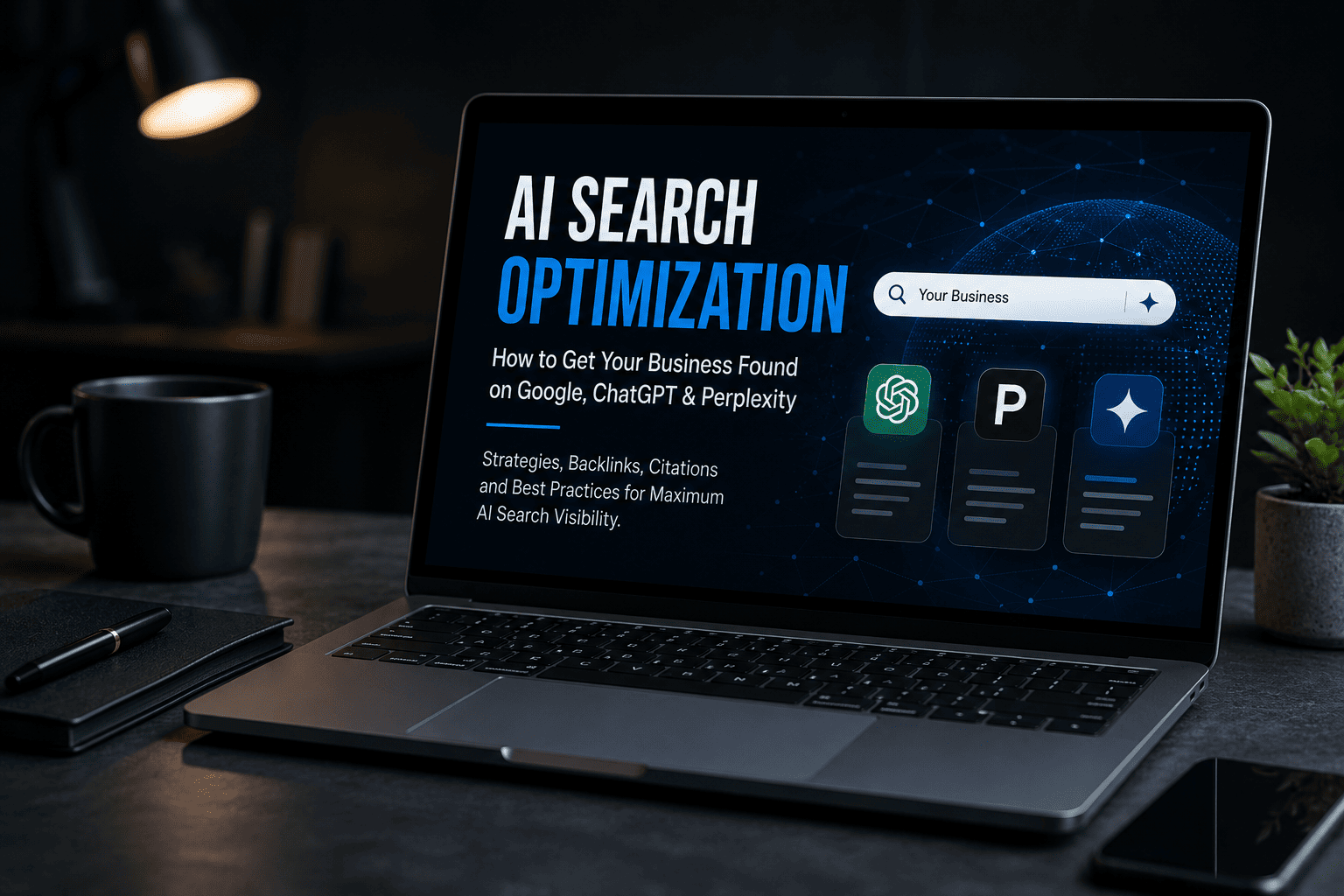
AI Search Optimization is the process of improving a website so that its information is easier for modern search systems and AI-powered search experiences to understand, retrieve, evaluate and potentially reference.
Traditional SEO was largely built around the idea of helping search engines discover, understand and rank web pages for specific queries. That remains important, but the way people search for information is changing. Instead of typing a short keyword and opening several results, users can now ask detailed questions and receive synthesized answers from systems that search, interpret and summarize information.
This change creates a new visibility problem for businesses. Ranking a page on Google is no longer the only question. A business also needs to consider whether its information is clear enough, authoritative enough and accessible enough to be used when an AI-powered search system builds an answer.
AI Search Optimization therefore sits at the intersection of traditional SEO, Answer Engine Optimization, Generative Engine Optimization, content strategy, technical SEO, structured data, authority and digital reputation.
Why AI Search Optimization Matters Now
Search behavior is becoming increasingly conversational. People are asking longer questions, comparing several options at once, requesting recommendations and continuing the conversation with follow-up questions.
Google has introduced generative AI experiences such as AI Overviews and AI Mode, while platforms such as Perplexity are designed around direct answers supported by web sources. These experiences create additional opportunities for websites to be discovered, but they also change the path between a user's question and a business website.
Google's current guidance is particularly important here: its AI search experiences still rely on core Search ranking and quality systems. In other words, AI search does not make SEO obsolete. Strong technical foundations, useful content, crawlability and original information remain important.
The opportunity is therefore not to abandon SEO and chase a completely separate algorithm. It is to build a stronger search presence that can work across traditional search and AI-driven discovery.
AI Search Is Not Just Another Keyword Strategy
One of the biggest mistakes businesses can make is treating AI Search Optimization as simply adding more keywords to existing pages.
AI systems can interpret context, relationships between concepts, entities and multiple pieces of information. A page can therefore be relevant to a question even when the exact wording of the question never appears on the page.
This means a strong AI search strategy should answer the real questions customers have instead of producing pages designed only around keyword repetition.
For example, a company selling accounting software should not only target a phrase such as "accounting software." It may also need useful content answering questions such as which accounting software is best for small businesses, how accounting automation works, what features matter for agencies, how much accounting software costs and what alternatives exist.
The objective is to build topical relevance and demonstrate genuine expertise around the problems the business solves.
AEO vs GEO vs SEO: What Is the Difference?
SEO stands for Search Engine Optimization. It covers the technical, content and authority-related practices used to improve visibility in search engines.
AEO stands for Answer Engine Optimization. The term is commonly used for strategies designed to make content easier for answer-oriented systems to understand and use when responding to questions.
GEO stands for Generative Engine Optimization. It is commonly used to describe optimization approaches aimed at improving visibility within generative AI search experiences.
These terms are useful for describing different aspects of modern search, but they should not be treated as three completely independent marketing systems.
Google's own 2026 guidance makes this distinction especially important. Google explains that its generative AI search features continue to depend on its core Search systems and recommends focusing on strong SEO fundamentals, unique content and user value rather than relying on artificial AEO or GEO tricks.
For a business, the practical approach is therefore simple: build a strong SEO foundation and extend it with content, entity clarity, structured information, authority and search visibility practices that make the website useful in AI-driven discovery environments.
How AI Search Engines Find Information
AI-powered search systems do not necessarily work like a traditional list of ten blue links.
Depending on the platform and search experience, an AI system may interpret the user's question, search the web, retrieve multiple sources, evaluate relevant information and synthesize the results into a response.
Perplexity describes its search experience in a similar way: it interprets the question, searches the internet, gathers information from authoritative sources, synthesizes the information and provides citations to the original sources.
This is important for website owners because it means that visibility can depend on whether the website becomes a useful source for a particular topic, not only whether one page happens to rank for one exact keyword.
Why Content Quality Matters for AI Search Visibility
AI search optimization does not mean producing thousands of generic AI-generated articles.
In fact, publishing large amounts of repetitive content without adding useful information can create the opposite of the desired effect. Google explicitly warns that using generative AI to create many pages without adding value can fall under its spam policies.
A strong AI search strategy should therefore prioritize original information, useful explanations, expert insights, examples, data, comparisons, practical guidance and clear answers to real customer questions.
The best content is content that would still be valuable to a human reader even if AI search did not exist.
Why Long-Tail Keywords Are Important for AI Search
Long-tail keywords are especially valuable because they often reveal a specific problem, question or buying intention.
Instead of targeting only broad phrases such as "SEO" or "digital marketing," a business can create content around searches such as "how to optimize my website for ChatGPT search," "how to get my business cited in AI search results" or "how to improve AI search visibility for a local business."
These queries are more specific and often indicate that the user is already trying to solve a particular problem.
Long-tail content also gives a website more opportunities to explain a subject deeply. When multiple related questions are answered across a coherent group of pages, the website can build stronger topical relevance.
How to Create Content That AI Search Can Understand
Clear structure is one of the most practical improvements a business can make.
Important information should not be hidden inside vague marketing language. A page should clearly explain what the business does, who it serves, what problem it solves, what makes its approach different and how customers can evaluate the offer.
Useful practices include:
- Use descriptive titles and headings.
- Answer important questions directly.
- Explain specialized concepts in plain language.
- Use relevant entities and terminology naturally.
- Support important claims with trustworthy sources.
- Keep important information accessible to search crawlers.
- Use internal links to connect related topics.
- Keep business information consistent across the website.
- Update pages when important information changes.
- Add original insights instead of rewriting what everyone else already says.
Why Structured Data and Schema Matter
Structured data helps describe information on a webpage in a format that machines can interpret more consistently.
Depending on the website, relevant Schema types can include Organization, Person, Article, Product, Service, LocalBusiness, BreadcrumbList, FAQPage and other appropriate structured data.
Schema should not be treated as a magic ranking button. Adding structured data does not guarantee a rich result, ranking improvement or AI citation.
Its value is clarity. When important information about an organization, product, article or service is explicitly represented, it can make the page easier for machines and search systems to interpret.
Why Backlinks Still Matter in AI Search
Backlinks remain an important part of a broader search visibility strategy because the web is built around relationships between pages and websites.
A backlink from another website can act as a signal that a page is worth referencing. But not all backlinks have the same value.
Building hundreds of low-quality links simply to increase a number is not a sustainable AI search strategy. The more useful approach is to build relevant, legitimate references from websites that make sense within the business's industry, market or topic.
For example, a cybersecurity company may benefit more from relevant mentions on technology publications, industry resources, business organizations or specialist websites than from a large collection of unrelated directories.
Backlinks can therefore contribute to the broader authority and discoverability of a website, while relevant external references can also help establish a stronger digital footprint around a brand.
Backlinks vs Citations: They Are Not the Same Thing
A backlink is a link from one website to another.
An AI citation is a reference shown within an AI-generated answer that points the user toward a source used to support the answer.
These concepts can be related, but they are not interchangeable.
Getting a backlink does not automatically create a citation in ChatGPT or Perplexity. Likewise, being cited by an AI search system does not mean that a business has built a large backlink profile.
The strategic objective is to build a website that is strong enough to be discovered, understood and considered useful across different search environments.
Why Brand Mentions and Digital Authority Matter
Modern search is increasingly contextual.
A business does not exist only as a URL. It exists as a brand, an organization, a service provider, a product, a founder, an expert and a collection of relationships across the web.
When a company is consistently described in relevant and trustworthy contexts, it becomes easier to understand what that company is associated with.
This is why a modern visibility strategy should look beyond a single website. Relevant publications, industry pages, directories, profiles, partnerships, reviews and other legitimate references can contribute to the broader digital presence of a business.
How to Improve Your Chances of Being Cited by AI Search
No legitimate SEO or AI Search Optimization service can guarantee that ChatGPT, Perplexity or another AI system will cite a specific website for a specific question.
AI systems change, search results change and the sources selected for an answer can change from one query to another.
What a business can do is improve the conditions that make its information more discoverable and useful.
A practical strategy includes:
- Create original and genuinely useful content.
- Build strong topical coverage around important customer problems.
- Improve technical SEO and crawlability.
- Make business entities and services clear.
- Use appropriate structured data.
- Build relevant internal links.
- Earn or build legitimate external references.
- Strengthen brand authority across relevant websites.
- Keep important information accurate and updated.
- Monitor how the brand appears across search and AI experiences.
AI Search Optimization for Local Businesses
Local businesses have another important opportunity: making their location, services and business information extremely clear.
A local business should maintain consistent information about its name, services, location, operating areas and contact details.
Content can also target questions customers actually ask, such as "best web developer for small businesses in..." or "AI SEO agency for local businesses."
Local relevance, helpful service pages, reviews, trustworthy references and a technically accessible website can work together to strengthen local search visibility.
AI Search Optimization for SaaS Companies
SaaS companies are particularly suited to an AI search strategy because potential customers often ask detailed comparison and problem-solving questions before buying.
Examples include:
- Best CRM software for small businesses
- Best AI automation tool for agencies
- Alternative to [competitor]
- How to automate customer support
- How much does marketing automation cost?
- Which project management tool is best for remote teams?
These searches create opportunities for comparison pages, educational guides, product documentation, use cases, FAQs and detailed solution pages.
The more clearly a SaaS company explains its expertise and solves real questions, the more useful its content becomes across traditional and AI-powered search.
AI Search Optimization for E-commerce Websites
E-commerce search is also changing.
Consumers increasingly ask questions that combine products, use cases, preferences and constraints. Instead of searching only for a product name, they may ask for the best product for a particular situation.
Product pages should therefore provide clear specifications, descriptions, use cases, comparisons, images, availability information where appropriate and other details that help users make decisions.
Category pages and buying guides can also address broader informational searches before the customer reaches the product page.
Technical SEO Is Still the Foundation
AI Search Optimization does not remove the need for technical SEO.
If search systems cannot properly access, crawl or understand a website, content optimization alone cannot solve the underlying problem.
Technical foundations can include:
- Crawlability
- Indexability
- Canonical URLs
- Mobile usability
- Page speed and performance
- Internal linking
- XML sitemaps
- Robots.txt configuration
- HTTPS and secure delivery
- Clean HTML structure
- Structured data
Google's current guidance for generative AI search reinforces this principle: websites still need to be accessible to crawling and indexing systems, and fundamental SEO practices remain relevant.
Why Internal Linking Matters for AI Search
Internal links help users move through a website, but they also help establish relationships between pages.
A strong website should not consist of isolated articles. Related pages should support one another.
For example, an AI automation agency could have a main AI automation service page connected to supporting articles about workflow automation, AI agents, customer support automation, lead generation and business process automation.
This creates a clearer topical structure and gives both visitors and search systems more context about the website.
Why One Article Is Not Enough
One highly optimized article can attract traffic, but a long-term search strategy usually requires a network of related content.
This is where the concept of a topic cluster becomes useful.
A pillar page can cover the main subject in depth, while supporting articles answer narrower questions. Internal links then connect those pages together.
For example, an AI Search Optimization pillar page can be supported by articles about AEO, GEO, ChatGPT search visibility, Perplexity citations, AI SEO, backlinks, structured data, long-tail keywords and entity optimization.
Each article can target a different search intent while contributing to the authority of the broader topic.
What Makes AI Search Content Trustworthy?
Trust is increasingly important when AI systems decide which information to surface or cite.
A trustworthy page should make it clear who is behind the information, what expertise or experience supports the content, where important facts come from and when information may need to be updated.
For businesses, this can mean using clear author information, company information, contact details, transparent service descriptions, credible references and original expertise.
EEAT should not be treated as a checklist that guarantees rankings. Instead, it is a useful framework for creating content that demonstrates experience, expertise, authority and trust.
AI Search Optimization Mistakes to Avoid
AI search is still evolving, which makes it tempting to follow every new tactic promoted online.
Some approaches are simply not worth building a strategy around.
- Do not publish hundreds of low-value AI-generated pages.
- Do not stuff pages with the same keyword repeatedly.
- Do not buy random low-quality backlinks in bulk.
- Do not create fake brand mentions.
- Do not assume a specific Schema type guarantees AI citations.
- Do not promise guaranteed ChatGPT or Perplexity placements.
- Do not ignore technical SEO.
- Do not copy competitors and simply rewrite their content.
- Do not optimize only for machines while creating a poor human experience.
The strongest strategy is usually less complicated: create something genuinely useful, make it technically accessible, explain the subject clearly, demonstrate expertise and build legitimate authority around the website.
How to Build an AI Search Optimization Strategy
A practical AI search strategy can be divided into several stages.
First, audit the website. Look at technical SEO, indexing, existing content, internal links, structured data, brand information and current search visibility.
Second, identify the topics and questions that matter commercially. This includes traditional keywords as well as long-tail conversational searches.
Third, build or improve the content architecture. Important services should have strong dedicated pages, while supporting content should answer relevant informational questions.
Fourth, improve the website's technical and semantic clarity. This can include Schema, internal linking, metadata, page structure and entity information.
Fifth, strengthen authority through relevant external references, backlinks, digital PR, partnerships and other legitimate forms of online visibility.
Finally, monitor performance and continue improving the content based on what users search for and how the search ecosystem evolves.
How Long Does AI Search Optimization Take?
There is no universal timeline.
Technical improvements can sometimes have an effect relatively quickly, while content authority and external references generally require more time to develop.
A new website with little authority should not be evaluated using the same expectations as an established domain with years of relevant content and references.
AI search visibility is also dynamic. A website can appear as a source for one question and not another. This is why a serious strategy should focus on improving the overall quality and authority of the digital presence rather than chasing one isolated citation.
How to Measure AI Search Visibility
Traditional SEO metrics such as organic clicks, impressions, rankings, indexed pages and conversions remain useful.
For AI search, businesses can also monitor brand mentions, citations, referral traffic from AI platforms where available, visibility for important conversational questions and changes in how the company is described across search experiences.
The most important metric is still business impact.
More visibility is valuable when it brings qualified visitors, leads, customers, subscribers or other meaningful actions.
AI Search Optimization Is Becoming Part of Modern SEO
The biggest misunderstanding about AI search is that businesses need to choose between SEO and AI Search Optimization.
They do not.
Technical SEO, useful content, authority, structured information, internal linking and strong user experience remain important. AI-powered search simply creates additional environments in which those assets can be discovered and used.
Google's current documentation makes this particularly clear: its generative AI search experiences are grounded in its existing Search systems, while its guidance continues to emphasize unique, useful and people-first content.
The opportunity is therefore to build a stronger overall search presence rather than chasing shortcuts.
Why Businesses Should Start AI Search Optimization Now
Search behavior rarely changes overnight, but the infrastructure behind discovery can change quickly.
Businesses that start building useful content, topical authority, technical foundations and a strong digital footprint today have more assets to work with as AI search continues to develop.
Waiting until AI search becomes the dominant discovery channel can mean starting from zero while competitors have already spent months or years building relevant content and authority.
There is also a practical advantage: the work done for AI search can strengthen traditional SEO at the same time.
A useful article can rank in Google and become a potential source for an AI answer. A strong service page can attract organic traffic and also explain a business clearly to machines. A relevant backlink can contribute to traditional authority while strengthening the broader digital presence of the brand.
Is AI Search Optimization Worth It?
For businesses that depend on online discovery, AI Search Optimization is worth considering because search is becoming more conversational, contextual and answer-oriented.
But it should not be sold as a magic technique or a guaranteed shortcut to ChatGPT citations.
The real value comes from improving the complete search ecosystem around a business: technical SEO, useful content, long-tail search coverage, structured information, internal linking, authority, backlinks, citations, brand clarity and ongoing optimization.
When these elements work together, a business has a much stronger foundation for being discovered across both traditional search and emerging AI-powered search experiences.
Smart Work helps businesses strengthen their visibility across Google and AI-powered search experiences through a combination of AEO, GEO, SEO, structured data, technical optimization, keyword research, competitor research, authority building and manual backlinking.
The goal is not to promise a guaranteed AI citation. The goal is to build a stronger digital presence that gives search engines and AI-powered systems more useful, clear and trustworthy information to discover.
Frequently Asked Questions About AI Search Optimization
What is AI Search Optimization?
AI Search Optimization is the process of improving a website's content, technical foundation, structure, authority and digital presence so it can be better understood and discovered in AI-powered search experiences as well as traditional search engines.
What is AEO?
AEO stands for Answer Engine Optimization. It generally refers to practices designed to make information easier for answer engines and conversational search systems to understand and use when responding to questions.
What is GEO?
GEO stands for Generative Engine Optimization. It is commonly used to describe strategies intended to improve visibility within generative AI search experiences.
Is SEO still important for AI search?
Yes. Google's current guidance states that its generative AI search experiences are built on its existing Search ranking and quality systems, making traditional SEO fundamentals important for AI search visibility.
How can I get my website cited by ChatGPT?
There is no guaranteed method to force ChatGPT to cite a website. A business can improve its chances by creating useful and trustworthy information, maintaining strong technical SEO, building relevant authority and making its content accessible and easy to understand.
How can I get cited by Perplexity?
Perplexity searches the web and provides answers supported by citations to original sources. Creating relevant, authoritative and accessible content can improve the opportunity for a website to become a useful source, but no specific citation is guaranteed.
Do backlinks help AI Search Optimization?
Backlinks can contribute to the broader authority and discoverability of a website. However, a backlink does not automatically create an AI citation. The quality and relevance of the overall digital presence matter more than simply increasing the number of links.
Do citations and backlinks mean the same thing?
No. A backlink is a hyperlink from another website to your website. An AI citation is a reference presented within an AI-generated answer that points to a source used to support that answer.
Does Schema help with AI search?
Structured data can make information about a page, organization, product or service easier for machines to interpret. However, Schema does not guarantee rankings, AI citations or visibility.
Can AI-generated content rank in Google?
AI can be useful for research, outlining and content production, but generating large amounts of low-value content without adding meaningful value can violate Google's spam policies. Human review, originality, accuracy and usefulness remain important.
How long does AI Search Optimization take?
There is no fixed timeline. Technical improvements, content development, authority building and external references can all have different timeframes. AI search visibility is also dynamic and can change as search systems and user queries evolve.
Is AI Search Optimization only for large companies?
No. Small businesses, agencies, SaaS companies, e-commerce brands, consultants and local businesses can all benefit from improving how clearly their expertise and services are represented online.
What does Smart Work include?
Smart Work's AI Search Visibility Optimization approach combines AEO, GEO and SEO with technical optimization, keyword and competitor research, structured data, local SEO where relevant, authority building and manual backlinking.
Your customers are already asking more detailed questions online. The opportunity is to make sure your business has useful, trustworthy and well-structured information ready to be discovered.
Smart Work combines AEO, GEO and SEO with technical optimization, structured data, keyword research, competitor research and manual backlinking to build a stronger search presence.